


Vineyard Management helping save 10-30% of vineyard irrigation water and improve grape quality in California vineyards
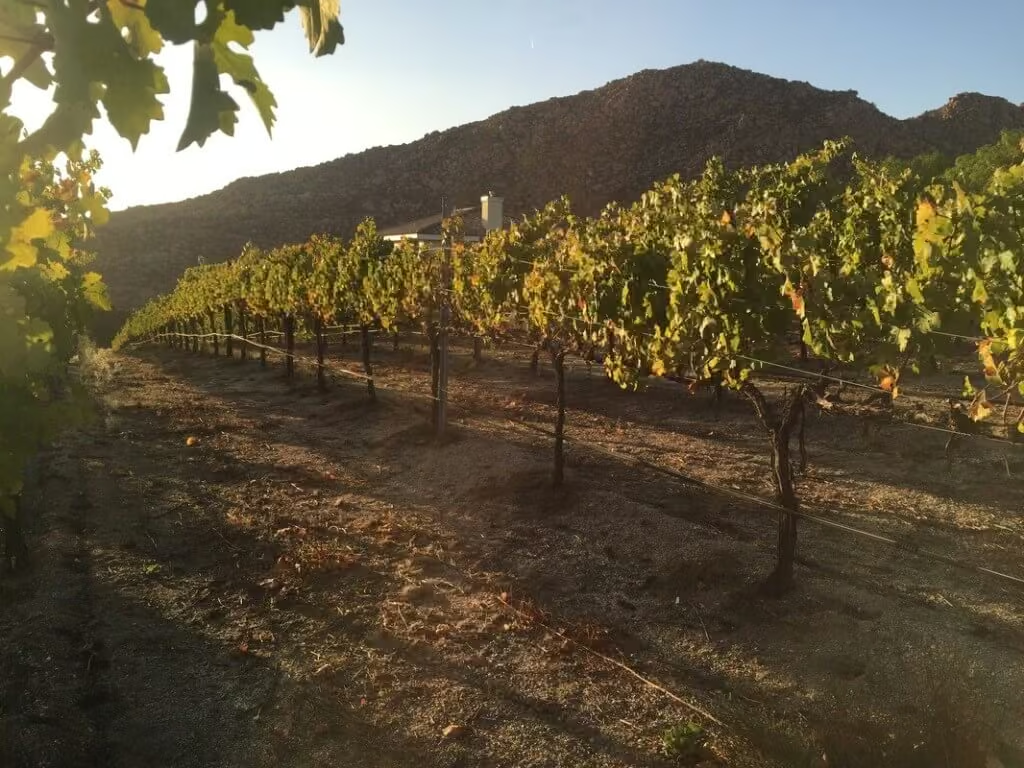
In order to grow, vines require, just like any other plant, certain amounts of water. The right amount of water availability is one of the very important factors for the vines, both from the perspective of short-term and long-term vine health, as well as from the perspective of the grapes that grow on that vine. By adjusting the amount of water that is delivered to a vine, winegrowers influence the quality of the grapes - and consequently the quality of the wine which is made out of those grapes.
There are many wine growing regions where irrigation of grapevines is not necessary, for example, large parts of Europe do not require any irrigation - it's even forbidden in some cases. However, there are areas where irrigation is necessary for the vines to thrive, or just to fill in the gap due to lack of water during the intensive vine growth period in the summer months. One such area is also California where vineyard irrigation is widely used to produce the highest quality wines. Due to limited water availability, winegrowers are committed to improving vineyard water usage efficiency, and use natural resources more sustainably.
At Vineyard Management, we work with Vinduino - a Californian company, which offers wireless devices for soil moisture measuring, irrigation control, and irrigation supervision. Vinduino devices work plug&play with Vineyard Management, so it is possible to review soil moisture, control the irrigation remotely and even automatically (or semi-automatically) with the help of Vineyard Management software.
And while this technology is currently being used by a number of vineyards, both in California and elsewhere around the world, we worked on a two measured case studies in California vineyards.
Regional installation
Over the seasons of 2017 and 2018, we worked with 8 participating wineries in a regional installation, which brought some very interesting insights on water savings with our technology. The wineries first used only soil moisture sensing to make better decision in this measured case study, while the next step was obviously to also include remote or automated irrigation control to make better use of the gathered data. However, in the numbers in this case study, only the savings achieved with the help of "being informed" are used.
The technology that was obtained from Vineyard Management and Vinduino lets farmers:
- Decide for how long to irrigate daily based on the ET data
- Decide when to start or stop irrigating based on the soil moisture sensor readings
10% total water savings
The results were astonishing: we learned that on average, all the wineries reduced their water usage by 10% between the seasons 2016 and 2017, and by 6.5% comparing the seasons 2016 and 2018 under the historically low rainfall conditions. In 2018, rain was in short supply, and in the area with the participating wineries, the year 2018 was among the driest years in recorded history. No other changes in irrigation practice were made over the observed years. Savings were achieved only by using daily irrigation time recommendations based on the ET data and soil moisture sensor readings and thus preventing over-irrigation and water runoff.
Apart from collecting ET and soil moisture data Vineyard Management and Vinduino lets farmers also to:
- Control valves remotely
- Monitor actual water usage
Fully automated irrigation
On top of collecting the soil moisture information and acting upon the collected information, the next step is irrigation control automation - at least to a certain degree. This can mean that irrigation can be started remotely by a farmer, or even in a completely automatic way. Automated irrigation control is estimated to add another 10% of water usage saving, based on research results and cases available today, as well as confirmed by a Test vineyard which had the complete solution deployed in 2018. It is important to note that all of those savings can be achieved completely without any impact on the vine's long-term or short-term health, or without any negative impact on the crop quality.
.avif)
Daily adjustment to evapotranspiration, which is calculated and presented in suggested irrigation time in minutes in Vineyard Management, can save 10% of irrigation water alone, by reducing irrigation time during colder periods. This was proven and tested in a vineyard which had a complete system installed for the season of 2018.
The graph above shows irrigation water usage from January to July for each year of the study in a Test vineyard, located in Temecula valley, California. Comparing the water usage in the years before and after the Vinduino sensors were installed into the Test vineyard shows a big drop in irrigation water usage. That's due to implementing Regulated Deficit Irrigation (RDI) practice in 2016. The Vineyard Management software together with the Vinduino soil moisture sensors gave winegrower the confidence to practice RDI, without being afraid of jeopardizing the existence of the vines.
Improved grape quality and lower labor costs
Apart from lowering the water usage for 10-30% depending on the technology and irrigation practice used, there is more to controlled irrigation. Practice like "Regulated Deficit Irrigation", where growers keep vines under a regulated stress to achieve a higher concentration of certain compounds in grapes, also helps farmers improve the quality of the grapes. By using the technology provided by Vineyard Management, with Regulated Deficit Irrigation calculations built-in, these practices are very straightforward and easy to implement and can help winegrowers achieve a higher quality of their yield.
There is no one straightforward metric to measure the effect of improved grape quality. However, higher-quality grapes usually translate into the better buying in price, which in our measured case study, in a Test vineyard in Temecula valley brought an additional $1750 income per acre. Since from higher-quality grapes a better wine can be made, which translates into a higher wine price per bottle. In our case, wine value due to 1 point higher quality on tastings added $12,600 per acre.
The use of valve controllers also helps winegrowers save on work costs as they don't need to travel to sites and manually open and close valves. Depending on the work costs, as well as on gas costs, savings differ; based on California industry average, about $250 on irrigation labor can be saved annually per acre.
Estimated Annual Savings Per Ace:
- Water: $237-462
- Labour: $250
- Wine Value Increase: +1 Point Per Ace: $12,600 - $20,840
All of the facts found in this case study speak for themself. The technology, provided by Vineyard Management and Vinduino, costs less than the water savings alone, which are achieved by using the technology. Besides saving water, remote and automated irrigation control also impact positively on the work costs, because travel to sites for manual opening and closing of the valves is not required, and added control and information in the topic of irrigation give winegrowers also the ability to achieve higher quality and conversely higher value of the crop in a sustainable way. It is simply a plain loss for the farmer to decide not to use this solution

